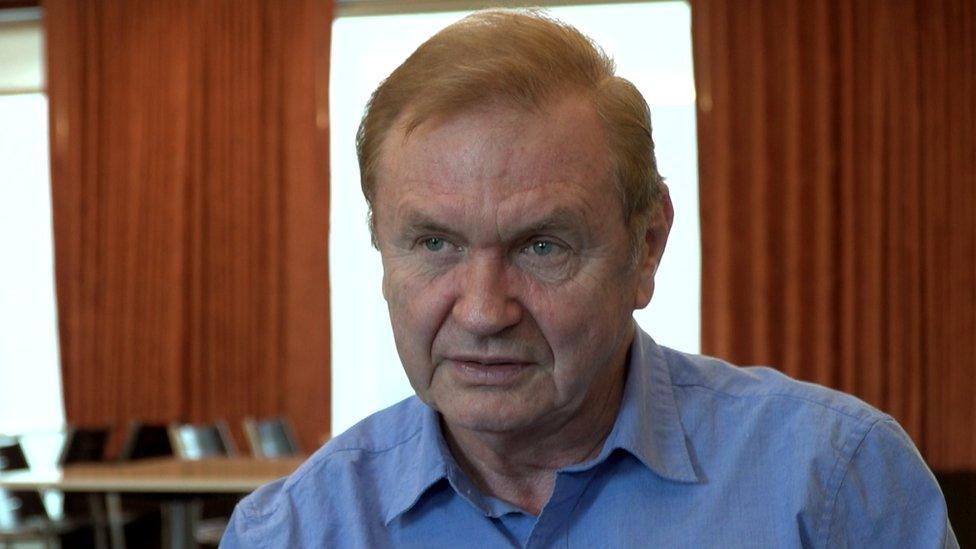
Early Life and Recruitment
- Jack Barsky was born Albert Dittrich in East Germany and showed promise in academics, initially studying to become a chemistry professor.
- He was recruited by the KGB in the mid-1970s, capitalizing on his intelligence and German background to serve espionage purposes.
- The KGB trained him in Moscow, focusing on creating a new identity and assimilating into American culture.
- Jack Barsky was a part of an elite group called ‘illegals’, meant to live under false identities in enemy territories.
Life in the United States
- Barsky was sent to the U.S. in 1978, living in New York under the alias William Dyson before becoming Jack Barsky.
- He constructed his American identity carefully, starting with a birth certificate found in a Washington cemetery.
- Without a U.S. passport, his espionage work was largely limited to low-level intelligence and adjusting to American lifestyle.
- He worked various jobs and lived as an ordinary citizen, gradually becoming well-incorporated into society.
Espionage and Challenges
- The KGB tasked Barsky with reaching high-level U.S. political networks, which was a significant challenge without a passport.
- He was involved in some industrial espionage and attempted to gauge the country’s mood during political tensions.
- Barsky had a considerable obsession with avoiding detection, often undertaking counter-surveillance missions.
Decision to Stay in the U.S.
-
In 1988, Jack Barsky faced a pivotal moment in his covert career when the KGB issued a recall, instructing him to return to the Soviet Union. Unbeknownst to his handlers, Barsky had developed strong emotional ties to the United States, driven primarily by his desire to remain near his daughter. This emotional bond became a decisive factor in his defiance of the order, marking a significant shift in his priorities from ideological allegiance to personal loyalties.
To justify his continued stay in the U.S., Barsky fabricated a medical condition, claiming to have contracted AIDS—a strategy he hoped would buy time and deter the KGB from insisting on an immediate return. Remarkably, he did not face severe repercussions for this deception, possibly reflecting an erosion in the KGB’s operational rigor at the time. Barsky’s decision encapsulates his transition from a loyal Soviet agent to a man seeking a stable and connected life in America.
- He faked having an illness to delay his return, buying time and attempting to avert the KGB’s wrath.
- Despite the risk from the KGB, Barsky did not face immediate danger, illustrating possible disconnects within the organization.
FBI Discovery and Life After Espionage
- The FBI eventually discovered his true identity during their investigations and approached him in 1997.
-
In a turning point of his life, Jack Barsky, confronted by the FBI with evidence of his espionage activities in 1997, chose cooperation over resistance. Accepting their offer, he began working with the agency to provide insights into KGB operations. His willingness to fully collaborate and demonstrate his detachment from the Russian intelligence facilitated a relationship of trust. As a result, the U.S. government allowed him to remain in the country and, eventually, he earned American citizenship—a remarkable transition for a former Soviet spy. This decision exemplifies his shift from serving as an “illegal” KGB agent to embracing his identity in the United States fully.
-
In 2015, Jack Barsky took a bold step by going public with his astonishing story as a former KGB spy. He shared his double life through interviews, including a renowned segment on “60 Minutes,” and wrote a memoir titled “Deep Undercover: My Secret Life and Tangled Allegiances as a KGB Spy in America.” The memoir detailed his espionage experiences, secret identities, and moral struggles. By revealing his covert operations and personal transformation, Barsky provided a rare glimpse into the secretive world of espionage and the complex journey of a “sleeper agent” who ultimately embraced a new American identity.
♠
Found a bug? Have some other thoughts on this tool? Let me know here →
![Protoparmeliopsis muralis, lichen crustacé saxicole couvrant de nombreux substrats artificiels[g].](https://ericknaus.com/wp-content/uploads/2026/02/Lecanora_muralis_-_Flickr_-_pellaea_1-150x150.jpg)