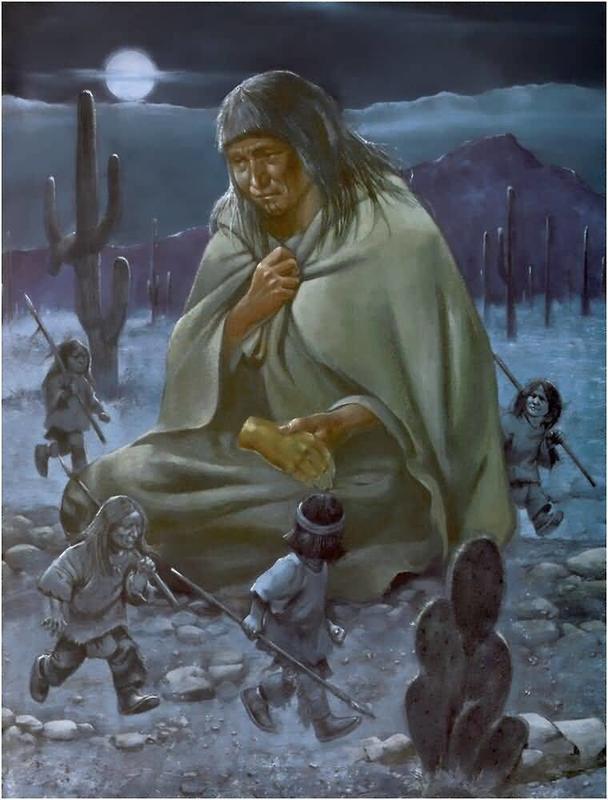
Folklore Traditions of the Little People
-
In Inupiaq tradition, tales of the Iñukuns hold profound cultural significance, portraying these supernatural beings as both mythical and influential over human lives. These tales, referred to as “unipkaat,” diverge from the English idea of legend as fictional, embodying a spiritual reality for the Inupiaq people. Narratives describe the Iñukuns exhibiting immense strength and mystic abilities, such as carrying caribou effortlessly, which underscores their otherworldly nature. These stories often blur the line between tangible reality and mythology, a hallmark of many indigenous oral traditions, emphasizing the depth of cultural interconnection to the natural and spiritual worlds.
Inupiaq accounts not only convey these beings’ extraordinary abilities but also provide a foundation for respecting the unknown. The Iñukuns are often represented as guardians of the land, living alongside humans yet inhabiting a separate, mystical plane. By intertwining spiritual beliefs and everyday experiences, these narratives encourage reverence for nature, community, and the mysteries of existence. Hunters, for instance, are advised against interfering with the Iñukuns to preserve balance and avoid unforeseen disruptions, subtly reflecting cultural ethos of harmony and restraint.
-
The Alutiiq people refer to the mythical “little people” as sungcuk, beings that occupy a fascinating space in their cultural storytelling. Descriptions portray sungcuk as playful entities, often indulging in mischievous activities like tying hair into knots while their human targets slept. However, their behavior was not solely limited to trickery; sungcuk were also remembered for their acts of generosity, assisting individuals during difficult times. This dual nature of mischievousness and benevolence underscores cultural perspectives on balance and morality, as these tales helped communities grapple with themes of unpredictability and the unseen forces shaping their daily lives.
- Stories of the little people often involve important cultural lessons, reflecting the values and beliefs of the Alaskan indigenous communities.
Cultural Significance and Stories
-
In the folklore of Alaskan indigenous communities, hunters are often cautioned against interaction with the “little people” to avoid their lives being disrupted—a deep symbol of respect for the unknown and mystical forces in nature. These tales emphasize a harmonious coexistence with all entities of the spiritual world, often warning that violations of this balance may result in unforeseen consequences. For instance, Inupiaq narratives speak of remarkable and surreal encounters where hunters, upon observing the little people, returned to find their communities irrevocably changed, highlighting both the temporal and spiritual dislocations such interactions might incur.
Such stories serve not just as warnings but as cultural lessons about humility in the face of the unknown. The reluctance to engage with these enigmatic beings reflects a profound recognition of their power and the reverence of boundaries in indigenous cosmology. This interplay between humanity and myth underscores the importance of respecting forces that exist beyond immediate human comprehension, a theme resonating deeply across diverse cultural narratives.
-
In numerous indigenous Alaskan legends, particularly from the Inupiaq, stories surface of individuals who vanish, only to resurface years later with recognition from their once-contemporary communities. These tales often attribute such disappearances to interactions with the Iñukuns, mystical “little people.” An illustrative story from the Inupiaq involves two hunters who observed the Iñukuns harvesting caribou but avoided direct contact. When they returned home, decades had passed, and many of their contemporaries presumed them dead. Such narratives do not merely serve as compelling folklore; they reflect cultural perspectives on time, spiritual dimensions, and the consequences of intersecting with the supernatural.
-
Drumming in Alaskan indigenous cultures transcends its auditory dimension, facilitating profound spiritual experiences. Embedded in rituals, the rhythmic pulses of drumbeats are often described as hypnotic, enabling participants to traverse between the tangible world and spiritual realms. This connection merges sensory and spiritual, ensuring that the stories of the past remain accessible and alive in the present. Such practices are integral to these communities, symbolizing their resilience in preserving intangible heritage amidst modernization, as their trance-like rhythms anchor them in cultural identity while fostering a shared sense of belonging and reverence for ancestral myths.
Modern Interpretations and Connections
-
Modern adaptations of myths often serve as a conduit for bridging historical authenticity and the intangible allure of folklore. Works such as Hulu’s “Blood & Myth” exemplify this by intertwining factual narratives with the mysticism surrounding Alaska’s Iñukuns. These adaptations not only captivate audiences but also preserve indigenous oral histories, as detailed by James Dommek Jr., whose account merges the real-life drama of a crime with long-standing cultural tales. Such storytelling underscores an evolving appreciation for native perspectives within mainstream media, where mythological elements no longer merely entertain, but illuminate cultural memory and resilience amidst modernization.
-
Modern media projects, such as Hulu’s *Blood & Myth*, showcase society’s enduring fascination with the mystical, intertwining cinematic narratives with the oral traditions of indigenous communities. By exploring the enigmatic Iñukuns—beings central to Alaskan folklore—this project illustrates how ancient stories can be repurposed to resonate with contemporary audiences. These tales are not merely relics but active conduits preserving cultural identity, as the adaptation of Teddy Kyle Smith’s life story into both a true-crime exploration and a spiritual odyssey illustrates.
Such media reflects a broader societal longing to reconnect with mythological roots, especially in an age dominated by rationalism. By bridging realism and folklore, modern interpretations enable audiences to access indigenous perspectives, lending a voice to oral traditions often jeopardized by modernization. These films and documentaries propose that folklore maintains its relevance and acts as a vessel for cultural survival while inviting new layers of dialogue around spirituality and identity.
- Discussions about the narratives remain relevant, offering insights into indigenous perspectives and cultural survival against modernization.
♠
Found a bug? Have some other thoughts on this tool? Let me know here →


![Protoparmeliopsis muralis, lichen crustacé saxicole couvrant de nombreux substrats artificiels[g].](https://ericknaus.com/wp-content/uploads/2026/02/Lecanora_muralis_-_Flickr_-_pellaea_1-150x150.jpg)