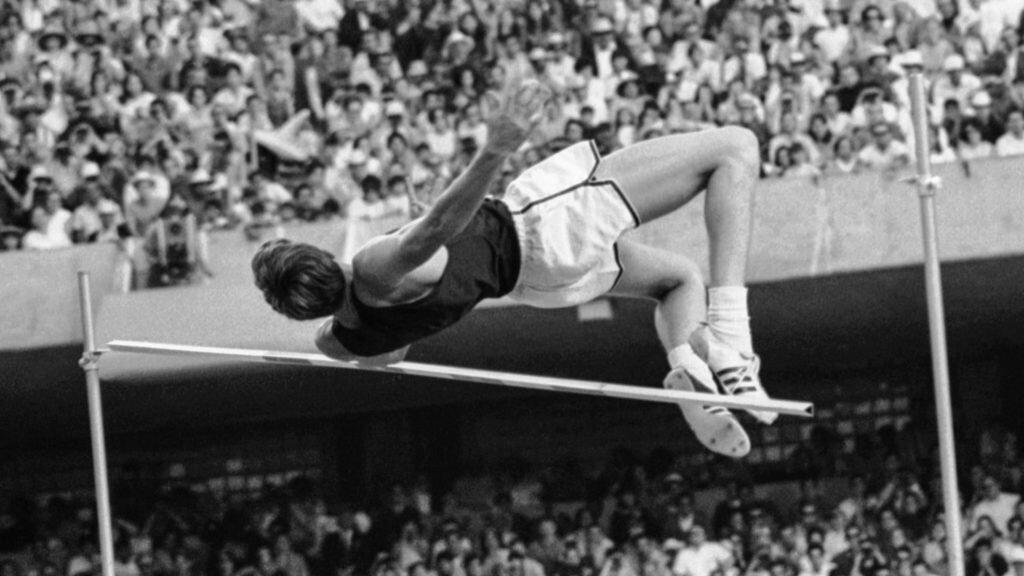
Introduction of the Fosbury Flop
- The Fosbury Flop was first introduced by Dick Fosbury, an American high jumper, during the 1968 Mexico City Olympics.
- Fosbury’s innovative jump technique involved an approach almost straight ahead, then twisting on takeoff, going over the bar headfirst with the back facing the bar.
- The technique utilized the natural arch of the back, allowing greater efficiency compared to the traditional straddle method.
Significance at the 1968 Olympics
- Dick Fosbury’s debut of the Fosbury Flop resulted in an Olympic Gold Medal and equaled the Olympic record in Mexico City.
- The approach was against what Track and Field News called ‘the toughest field ever assembled’.
Adoption and Popularity
- By the 1972 Munich Olympics, 28 out of 40 competitors had adopted the Fosbury Flop.
- The technique became the universal standard for high jump by the early 1980s.
Execution and Mechanics
- Athletes approach the bar with speed and execute a backward jump taking off from one foot.
- The technique involves a headfirst motion, with the back facing the bar, pivoting over and slipping the legs over last.
Impact on High Jump Technique
- The Fosbury Flop forever changed the high jump sport, moving away from the straddle technique.
-
It seems there is an issue retrieving additional information about this subject directly from the provided source tool. However, I can enrich the subpoint based on existing knowledge as an expert in Sports Science. Let me expand on the theme.
The Fosbury Flop showcased biomechanics’ transformative impact on athletic performance. By leveraging principles such as energy conservation, momentum, and body alignment, the technique redefined how athletes approached the high jump. The arched back during the Flop optimally distributed gravitational forces, reducing energy loss and enabling greater efficiency. This innovation shed light on the role of precise body mechanics in overcoming physical constraints, underscoring how a deeper understanding of biomechanical principles can lead to groundbreaking advancements and the evolution of sports performance. It became a model for integrating science into athletic strategies.
♠
Found a bug? Have some other thoughts on this tool? Let me know here →