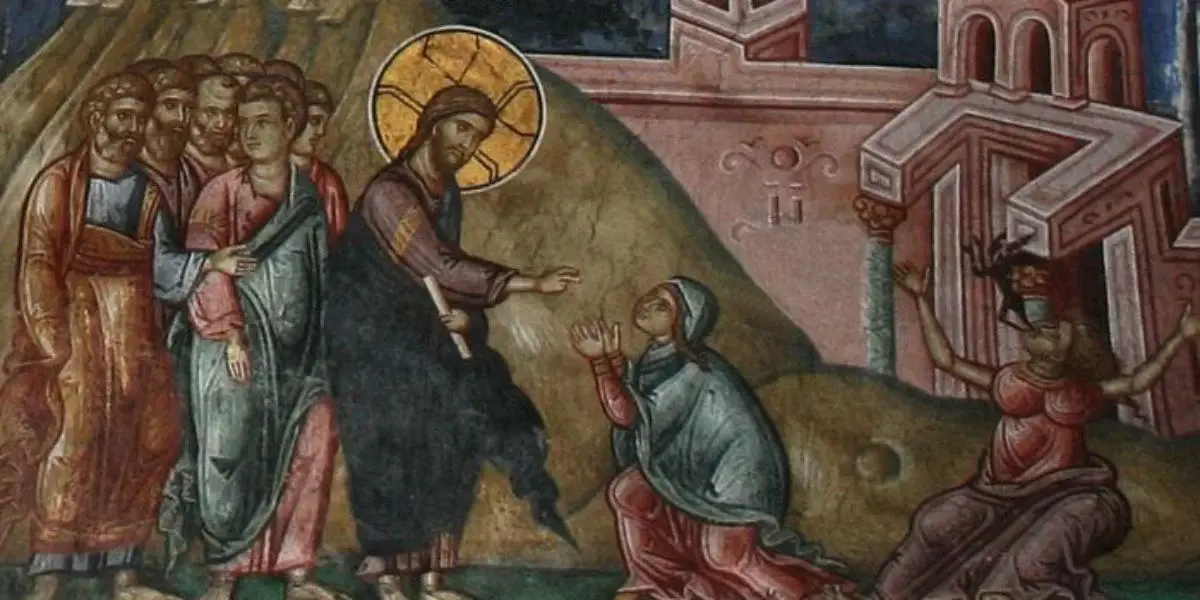
Faith and Humility as Exemplified by the Canaanite Woman
- The Canaanite woman addresses Jesus as the ‘Son of David’, recognizing Him as the promised Messiah even as a Gentile.
- Her use of the term ‘crumbs’ indicates her willingness to receive any measure of grace Jesus could offer.
-
The Canaanite woman’s response to Jesus, as recorded in Matthew 15:21–28, is a profound demonstration of humility and unwavering faith. Despite Jesus initially dismissing her pleas, she remained steadfast, reflecting her deep understanding of His power and mercy. Her reply, “Even the dogs eat the crumbs that fall from their master’s table,” illustrates not only her humility but also her recognition of even the smallest act of divine grace as transformative. She did not demand entitlement but approached with unwavering belief that even an undeserving supplicant could receive favor if persistent in faith.
This humility and persistence are significant, as they highlight an essential aspect of theological teaching: faith without pride is elevating. By acknowledging Jesus’ mission to Israel without resentment or argument, the woman demonstrated an extraordinary ability to persist despite cultural and religious barriers. Her reaction becomes a living parable of faith that trusts, even when the outcome is uncertain. This story exemplifies the kind of faith that can move Jesus to act, regardless of societal perceptions or initial rejections.
Jesus’ Pedagogical Approach
- Jesus’ initial silence and refusal were designed to draw out the woman’s faith for a teaching moment.
- The disciples and onlookers were shown that faith exists outside traditional Jewish boundaries.
- The scenario was used to challenge and expand prevailing religious and social norms.
Inclusivity of God’s Grace
-
The narrative of the Canaanite woman is a profound scripture that emphasizes God’s grace transcending cultural and social barriers. Despite being a Gentile, traditionally marginalized in Jewish society, the woman’s faith and persistence positioned her to receive divine favor. This account vividly illustrates the expansive nature of God’s grace, extending His compassion to those once deemed outsiders. The interaction showcases that righteousness and faith supersede ethnicity and heritage in the eyes of God.
This story also acts as a precursor to the universal message of the Gospel—the eventual inclusion of Gentiles into the faith. It underscores that God’s grace is not confined by human limitations and affirms the all-encompassing love of the divine for all humanity, regardless of societal boundaries.
- The ‘crumbs’ symbolize the beginning of a broader sharing of salvation to Gentiles.
- This encounter foreshadows the inclusion of Gentiles into the Christian faith as seen later in Acts.
The Role of Persistent Prayer
-
The Canaanite woman’s relentless pleading demonstrates a profound example of the power of persistent prayer, as depicted in Matthew 15:21-28. Despite Jesus’ initial silence and rejection, she persistently called out, driven by her unwavering faith and earnest desire for her daughter’s healing. This act symbolizes the strength of faith in overcoming barriers, whether cultural, ethnic, or spiritual. Her determination exemplifies the spiritual practice of ceaseless prayer, emphasizing its importance as a means to connect with God and affirm faith. Her eventual success—Jesus granting her request—underscores the belief that persistence in prayer can lead to divine blessings and grace.
- Her response and refusal to give up serve as an example of unwavering faith.
- Persistence in prayer is highlighted as significant for receiving God’s grace.
♠
Found a bug? Have some other thoughts on this tool? Let me know here →
![Protoparmeliopsis muralis, lichen crustacé saxicole couvrant de nombreux substrats artificiels[g].](https://ericknaus.com/wp-content/uploads/2026/02/Lecanora_muralis_-_Flickr_-_pellaea_1-150x150.jpg)