Establishment and Importance of Fort Bridger
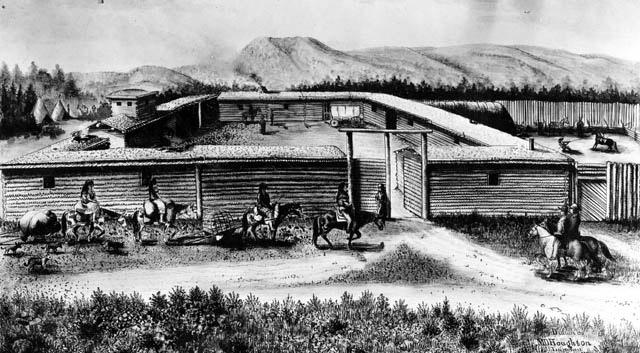
- Fort Bridger was established in 1843 by Jim Bridger and Louis Vasquez as a trading post in present-day Wyoming.
- Its initial function was to serve as a vital resupply point for emigrants on the Oregon, California, and Mormon trails, offering essential supplies and services.
- The fort consisted of two double-log houses and a pen for horses, later expanding due to its strategic location.
Mormon Influence and Conflict
-
Mormons became involved with the fort after realizing its strategic benefit for their own settlement plans.
The Mormons recognized the strategic importance of Fort Bridger due to its location along major westward migration routes, such as the Oregon, California, and Mormon trails. As the Church of Jesus Christ of Latter-day Saints (LDS Church) sought to establish their settlements in the isolated Utah Territory, control over critical resupply and trade points became a priority. Fort Bridger presented an opportunity not just for strategic trade advantage but also for asserting territorial influence in the growing friction between Mormon settlers and non-Mormon emigrants.
By the early 1850s, Mormon leaders, including Brigham Young, recognized the need to integrate these pivotal outposts into their settlement network. Their involvement with the fort reflected broader settlement strategies aimed at economic self-sufficiency and territorial governance. This expanded their reach and fortified the Mormon Corridor, allowing the LDS Church to manage interactions with travelers and enhance their role as stewards of the frontier. However, such ambitions eventually heightened regional tensions, especially with the fort’s founder, Jim Bridger, setting the stage for conflicts during the Utah War and beyond.
- In 1853, the Mormon militia attempted to take control of Fort Bridger, leading to tensions with Jim Bridger.
-
Bridger accused Mormons of stealing goods and burning the fort, escalating further conflicts.
Jim Bridger, a seasoned frontiersman and co-founder of Fort Bridger, played a central role in the escalating tensions between himself and the Mormon settlers during the mid-19th century. Bridger alleged that Mormon settlers had begun seizing goods from the fort without proper compensation, actions he considered outright theft. He further accused them of intentionally burning the fort in 1853, an act that symbolized their attempts to undermine his control over this crucial trading post. These accusations intensified existing animosities between Bridger and the Mormon community, as the fort’s strategic and economic significance made it a focal point of competing interests. The resulting conflict not only displaced settlers but also highlighted the broader territorial and cultural disputes shaping the American West during this period.
Military Significance and the Utah War
- The U.S. Army occupied Fort Bridger during the Utah War (1857-58) as part of a federal campaign to reassert control over the Mormon-dominated territory.
- Mormons burnt the fort in 1857 to prevent its use by the advancing federal army.
-
After the war, the U.S. government refused to honor claims to Fort Bridger from both the Mormons and Bridger himself, managing it as a national asset.
Following the Utah War, Fort Bridger’s ownership became a contentious issue, with both the Mormons and Jim Bridger asserting claims over the site. Jim Bridger argued that he had established the fort and was entitled to its ownership, while the Mormons contended that they had legally acquired the property during their occupation of the Utah Territory. However, the federal government, aiming to reassert authority in the region post-conflict, dismissed these claims altogether. Instead, the U.S. government assumed control of the fort, recognizing its strategic value as both a military outpost and a gateway to western expansion. By managing Fort Bridger as a national asset, the government solidified its foothold in territory previously influenced by competing private and religious powers, ensuring the fort’s role in advancing U.S. interests in the West. This decision underscored the shifting dynamics of land ownership and governance in the contested frontier region.
Historical Legacy and Modern Preservation
- Fort Bridger became less critical after 1869 when the Union Pacific Railroad bypassed it.
- In 1933, the site was designated as a Wyoming Historical Landmark and Museum.
- Today, Fort Bridger is managed as a state historic site, offering self-guided tours, living history demonstrations, and archaeological explorations.
♠
Found a bug? Have some other thoughts on this tool? Let me know here →